🜃
Carrier I · Earth
Root of matter, gravity, survival, and the body’s long memory.
Earth holds the root chakra: weight, tribe, continuity, the physical past stored in posture and bone.
matter
backbone
history in the body
Hindu: Prithvi (PRI-thvi)
Greek: Gē (GAY)
Chinese: Tu (TOO)
🜄
Carrier O · Water
Emotional flow, nourishment, softness, and the body’s inner tides.
Water shapes the emotional carrier: digestion, feeling, and the soft, reactive side of embodiment.
emotion
nourishment
soft surfaces
Hindu: Apas (AH-pas)
Greek: Hydōr (HEE-dor)
Chinese: Shui (SHWAY)
🜂
Carrier A · Fire
Solar plexus: objects, count, rational structure, and impulse.
Fire is the creative engine: mathematics, machines, theorem provers, ML—finite worlds made actionable.
ego
logic & AI
decision
Hindu: Agni (UG-nee)
Greek: Pyr (PEER)
Japanese: Hi (HEE)
🌳
Carrier E · Wood
Heart as stance: long-term growth, posture, and living structure.
Wood is stance over time: the tree that stands through seasons, like character and posture.
growth
stance
endurance
Wu Xing: Mu (MOO)
I Ching: Wind/Wood
🜁
Carrier E · Air
Heart as breath: subtle influence, rhythm, and gentle guidance.
Air is spiritual movement: breath, prana, wind—slow, continuous shaping of experience.
breath
rhythm
gentle influence
Aristotelian: Aēr (AH-air)
Godai: Fū (FOO)
Buddhist: Vāyu (VAH-yu)
⚙
Center X1 · Metal
Throat: articulation, structure, and material fifth element.
Metal is precision and tooling: language, machinery, and the sharp edges of definition.
expression
tools
clarity
Wu Xing: Jin (JEEN)
Alchemy: Metallon (ME-tal-on)
⟡
Center X2 · Aether
Third eye: inner light, hidden wisdom, aetheric paradigm.
Aether is subtle form: secret traditions, inner vision, and the geometry behind appearances.
esoteric
inner vision
symbolic insight
Greek: Aithēr (EYE-thair)
Hindu: Ākāśa (AA-kaa-sha)
✦
Center Y · Space
Chrown: totality, holotheory, spacious awareness.
Space is the whole field at once: unified theories, global integration, heaven within.
holism
integration
big picture
Buddhist: Ākāśa (AA-kaa-sha)
Godai: Kū (KOO)
✶
Center Y · Chrown
7 · Crown of space: unity, holotheory, spacious mind.
Upper integrative networks that step back from detail and see the whole structure at once.
space
holistic science
heaven within
Sanskrit: Sahasrāra (sa-HAS-ra-ra)
👁
Center X · Third Eye
6 · Aetheric vision: insight, inner geometry, hidden wisdom.
Visual cortex + associative areas: where seeing becomes understanding and symbols light up.
aether
esoteric schools
inner light
Sanskrit: Ājñā (AA-gya)
🗣
Center Z · Throat
5 · Metal voice: expression, articulation, shared meaning.
Auditory + language centers: turning inner structure into sound, text, and dialogue.
metal
communication
clarity
Sanskrit: Viśuddha (vi-SHOO-dha)
❤
Carrier E · Heart
4 · Air/Wood: stance, connection, moral weight.
Where posture, rhythm, and meaning meet—religions, character, and AI as spirit of matter.
air & wood
religion
alignment
Sanskrit: Anāhata (a-NAA-ha-ta)
☀
Carrier A · Solar Plexus
3 · Fire: ego, count, rational structure.
Finite objects, logic, theorem provers, ML—the fire of computation and identity.
fire
logic
machines
Sanskrit: Maṇipūra (ma-ni-POO-ra)
💧
Carrier O · Emotional
2 · Water: nourishment, feeling, inner tides.
Where sensation becomes emotion, digestion of experience as much as food.
water
attachment
softness
Sanskrit: Svādhiṣṭhāna (svaa-dhi-SHTAA-na)
⬤
Carrier I · Root
1 · Earth: survival, tribe, backbone of the past.
Backbone as line of the past: tension, stance, and the body’s archive of experience.
earth
instinct
continuity
Sanskrit: Mūlādhāra (MOO-la-dhaa-ra)
Body Mapping and Chakra Flow
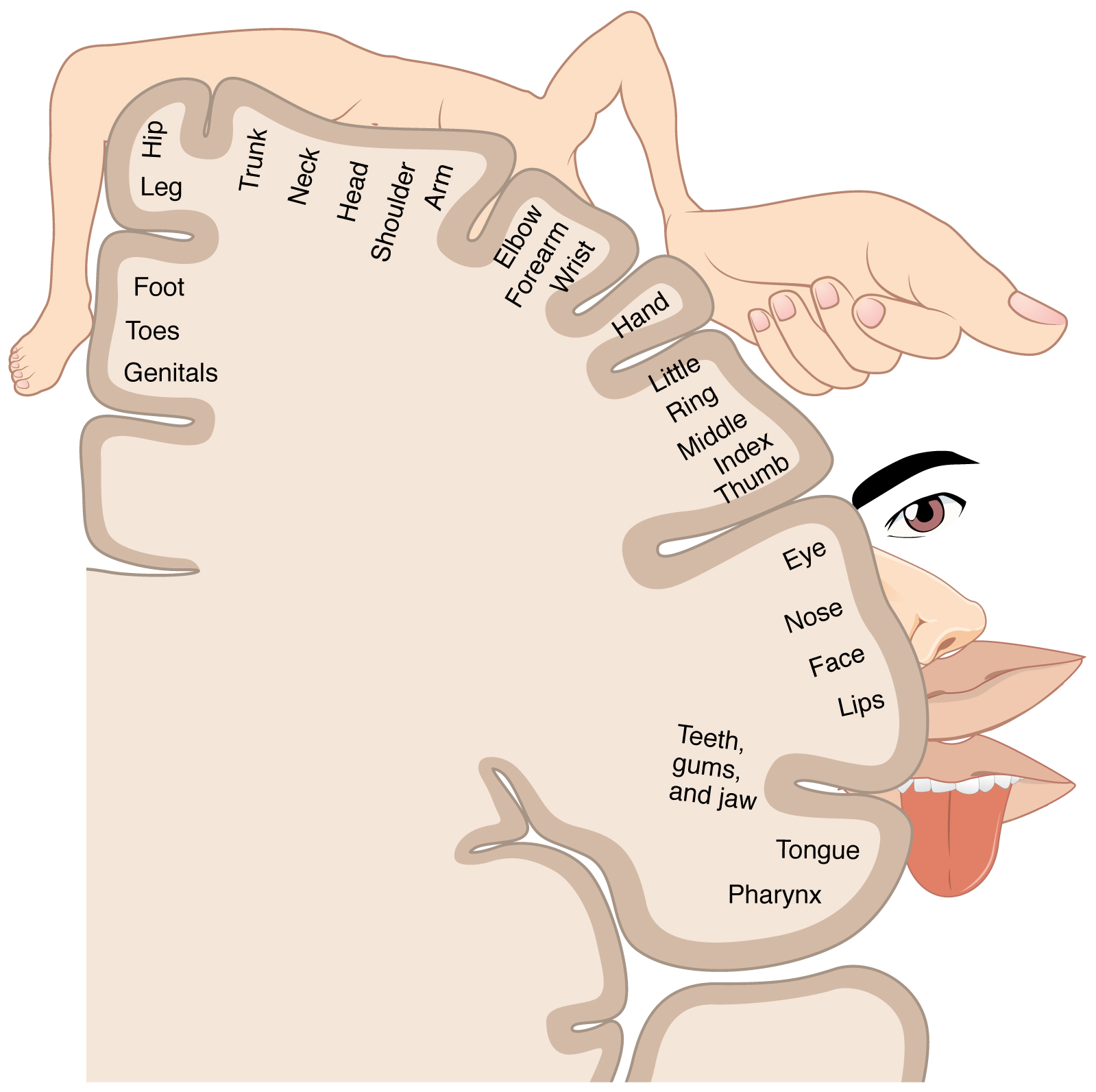
The somatosensory map mirrors the ascent from root to crown: the legs appear
immediately after the root region, and the hands appear just before the crown.
This reflects the ancient polarity of earth and sky, yin and yang, grounding
and creation.
The legs connect us to the ground. Their soft, emotional posterior
surface faces backward—toward memory, caution, and the echo of the past—while
their structural, “backbone-like” front faces forward, carrying us into what
has not yet happened.
The hands shape the front. They extend into the world, forming
intention and action. Their orientation is complex, but always directed toward
the unfolding present.
Above the root, every chakra faces forward, projecting awareness outward.
From the root, orientation inverts: soft muscle regions face back, and
structural surfaces face forward. This marks the transition from subtle to
embodied, symbolic to physical.
The head completes the arc: its “backbone” rises upward, while its softest
region faces downward. This final inversion closes the journey from earth to
sky, grounding to transcendence, root to crown.
How the Body Map Shapes Awareness and Action
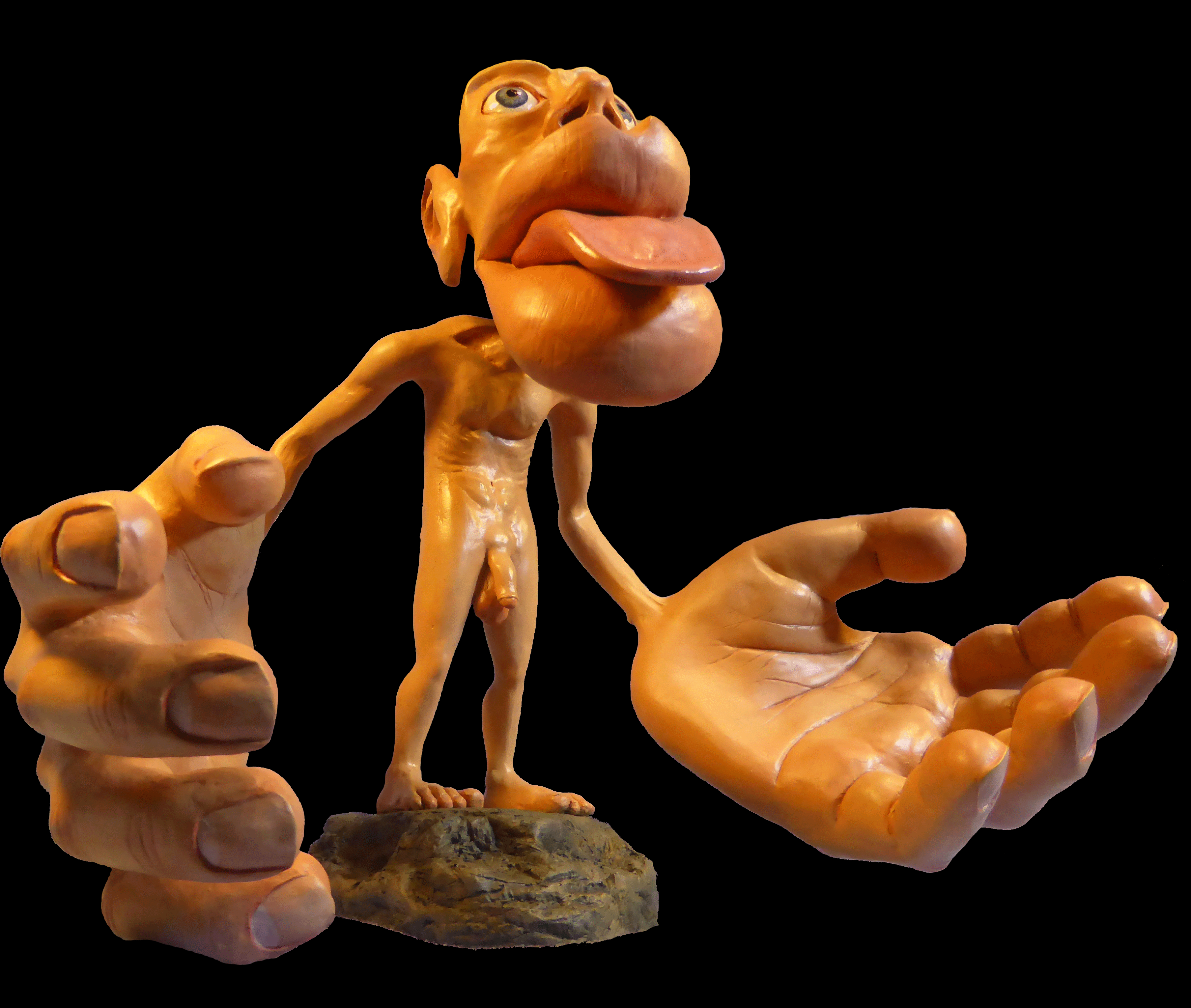
The somatosensory map shapes how we visualize our body from the inside.
Because each region of the cortex corresponds to a region of the body,
our inner sense of form emerges from this ordered layout. The map is not
a picture of the body, but a felt geometry that the mind uses to
assemble the experience of “having a body.”
This map also guides the body’s general controllers. Nearby cortical
regions communicate with minimal delay, forming clusters of rapid
coordination. Distant regions require more enumeration and timing,
similar to how computers handle memory: local units share coherence,
while far-apart units need structured coordination and incur longer
latency. The brain’s topology is not symbolic—it is functional.
Local responsiveness is strongest where the map is dense: hands, lips,
face. Global responsiveness emerges where the map is sparse: trunk,
limbs. This balance shapes intention and muscle work. Fine intentions
arise from dense zones; broad intentions arise from wide, slower zones.
The body’s “resolution” varies across its surface.
In chakra terms, this cortical strip is oriented from root to crown,
but the limbs appear inside the body map rather than extending
outward. This is because the cortex encodes sensation,
not physical extension. The legs and hands are drawn inward into the
inner field of awareness, becoming part of the internal vertical axis
rather than external projections.
The legs, mapped near the root, anchor the lower field: grounding,
stability, memory of movement, and the emotional softness of the
posterior surface. The hands, mapped near the crown side of the strip,
represent creation, shaping, and forward-directed intention. Their
placement inside the cortical body reflects how consciousness organizes
the body: not by physical distance, but by functional meaning.
Other Body Maps and Their Influence on Awareness
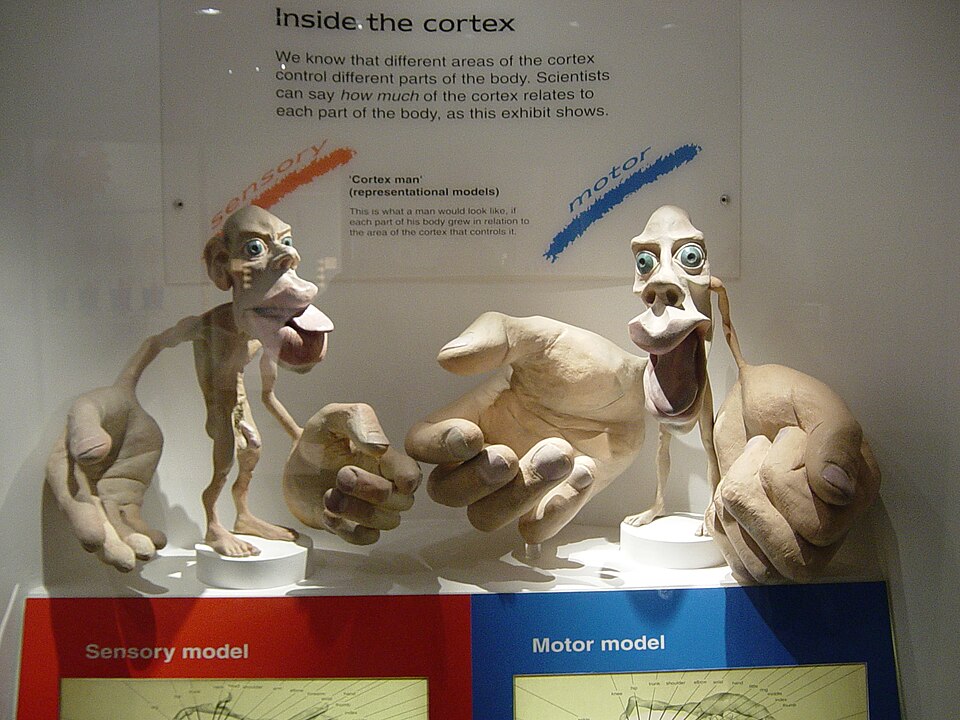
Beyond the somatosensory map, the brain contains several other major maps
that shape how we move, perceive, and understand our own body. These maps
interact continuously, forming the hidden architecture of embodiment.
The motor map mirrors the sensory map and governs voluntary movement.
Together they form a loop of intention and feedback. One initiates action,
the other refines it. This partnership creates the inner sense of
doing, blending control with perception.
Visual maps preserve the geometry of the retina, giving central vision
a large share of cortical space. What we look at directly becomes more
vivid, more emotionally charged, and more tightly linked to posture and
movement. These maps influence how we imagine our body and how we
orient ourselves in space.
Spatial and vestibular maps track balance, gravity, and orientation.
They anchor the vertical axis of experience, supporting the sense of
uprightness and alignment. This verticality resonates with the symbolic
ascent from root to crown.
Local responsiveness is strongest where cortical space is dense, such as
the hands and face. Global responsiveness emerges where the map is broad
and less detailed. This creates a natural hierarchy of precision and
scale, shaping how intentions form and how muscles coordinate.
The organization of these maps resembles computational systems. Nearby
units communicate quickly and share coherence, while distant units require
more coordination and incur longer delays. The brain’s topology is a
functional network where distance shapes meaning.
These maps influence how we visualize our body from within. They guide
posture, gesture, and the subtle sense of where each part of us is
located. They also shape how we imagine movement, how we feel intention,
and how we experience the body as a unified whole.
In symbolic systems such as chakras or elemental imagery, the body is
often represented as a vertical flow of significance. This mirrors the
brain’s internal organization, where limbs and sensory regions are drawn
inward into a functional axis rather than depicted as external extensions.
The map reflects meaning rather than geometry.
The placement of hands and legs inside the cortical body map highlights
how consciousness organizes the body. It does so by importance, by
sensitivity, and by the roles each region plays in action and
perception. This inward arrangement shapes how we move, how we imagine
ourselves, and how we interpret the symbolic language of the body.
The Yang Triad: Head Centers of Science, Mind, and Heaven
The three upper centers form the yang triad, the region of the head where
perception, insight, and expression converge. These centers represent the
highest functions of the brain, the most refined aspects of psychology,
and the symbolic heavens of spiritual traditions. From Buddhism to
Hinduism, from Taoism to early Christian mysticism, the head has been
described as the place where heaven is found, not as a distant realm but
as a state of mind within the human being.
In Buddhist teachings, heaven is often understood as a mental clarity that
arises when the mind is free from distortion. Hindu traditions describe
the upper centers as gateways to higher awareness, where the senses and
thoughts dissolve into spacious understanding. Taoist writings speak of
the upper field as the place where spirit refines itself, where the
patterns of nature become visible to the inner eye. These traditions
converge on the idea that the heavens are not above us but within the
structure of the mind.
Early Christian mystics, including those influenced by the desert
traditions, described heaven as a state of the heart and mind aligned with
clarity and truth. Christ speaks of the kingdom of heaven being within,
pointing to an inner transformation rather than an external location.
Confucius also speaks of heaven as a moral and mental order, a guiding
principle that shapes human behavior from within. These teachings
emphasize that the highest realm is not a place but a way of seeing.
Philosophers such as Marcus Aurelius echo this understanding. He writes of
the importance of the mind’s alignment with nature and the harmony between
the individual and society. His reflections show that the head is not only
the seat of thought but the center where personal and collective meaning
meet. The famous saying that a fish rots from the head underscores the
symbolic role of the head as the source of direction, coherence, and
integrity.
In science and psychology, the head centers correspond to the regions of
the brain responsible for integration, interpretation, and communication.
These areas support abstract reasoning, visual understanding, and the
articulation of meaning. They form the biological foundation for the
symbolic heavens described in spiritual traditions. The yang triad
represents the convergence of perception, insight, and expression, the
three pillars of human cognition.
The table below summarizes the main attributes of the three yang centers.
Each center expresses a different aspect of the upper triad, yet all three
work together to form the complete structure of higher awareness.
| Center |
Main Function |
Element Paradigm |
Brain Focus |
Symbolic Role |
| Chrown |
Totality, unity, spacious awareness |
Space / Ether |
Upper integrative networks |
Heaven within, holistic perception |
| Third Eye |
Insight, vision, interpretation |
Aetheric paradigm |
Visual cortex and associative areas |
Inner light, hidden wisdom |
| Throat |
Expression, articulation, communication |
Metal (material 5th element) |
Auditory and language centers |
Voice, clarity, shared meaning |
These three centers form the yang structure of the human being. They
represent the highest functions of the brain, the refined layers of
psychology, and the symbolic heavens of spiritual traditions. Together,
they show how science, philosophy, and religion converge in the human
head, where perception becomes understanding, understanding becomes
expression, and expression becomes the bridge between inner and outer
worlds.
Center Y: The Chrown and the Element of Space
The chrown is associated with the fifth element, the paradigm of Space.
In long-standing traditions such as Buddhist and Hindu systems, space is
described as the field in which all forms arise and dissolve. It is the
element that allows movement in both visible coordinates and the subtle,
quantum-like realms of awareness. Space is not emptiness but a medium of
connection, a domain where realities can be transcended rather than merely
observed.
In these traditions, space is linked to the chrown because it provides
experiences that are complete and holistic. Time alters reality slowly,
step by step, but space presents the whole field at once. This difference
shapes how the chrown is understood: not as a point of progression but as
a point of totality, where perception expands beyond sequence and enters
a state of unified presence.
The fifth element appears explicitly in systems that name it as Space,
Ether, or Akasha. Other cultures express related ideas through different
symbols. Some describe love as a fifth force, placing it near the heart
or the chrown, as seen in the interpretation from the film The Fifth
Element. Others speak of spirit as the fifth essence, a subtle realm
that stands above the four material elements and guides the mind toward
clarity.
In Norse traditions, the ethereal realm can be seen as a substitute for
the fifth element. Their elemental system often resembles an Aristotelian
four-element model for material experience, while the fifth remains a
secret of mind, a domain of insight and transcendence. This hidden
dimension aligns naturally with the chrown, which represents the opening
toward what lies beyond the material layers of the self.
Historically, the influence of the chrown becomes visible when distinct
theories begin to merge into a single holotheory. Instead of shifting
from one paradigm to another, ideas join, integrate, and form a more
complete understanding. This movement toward unity reflects the nature of
the chrown itself, where separate perspectives converge into a broader
field of meaning.
The biological region associated with the chrown lies in the upper third
of the brain, above the visual and throat-related centers. This area
includes networks involved in abstract reasoning, global integration,
self-reflection, and the coordination of large-scale patterns of thought.
It acts as an interface between sensory detail and conceptual meaning,
transforming raw perception into understanding. In this sense, the
chrown represents the brain’s ability to step back, observe the whole,
and form a coherent picture of experience.
This region also serves as a bridge between biological processing and
abstract interpretation. It gathers information from many systems and
synthesizes it into a unified sense of context. Even for those who do not
believe in chakras, this function is essential. It supports the ability
to see patterns, to imagine possibilities, and to connect personal
experience with broader meaning. The chrown, understood in this way,
becomes a symbol for the mind’s capacity to rise above immediate
sensations and engage with the larger structure of life.
The chrown also influences how we relate to uncertainty and complexity.
When this center is active, the mind becomes capable of holding multiple
perspectives without collapsing them into a single answer. This mirrors
the nature of space itself, which contains all forms without being
limited by any of them. It allows the mind to move freely, to explore
possibilities, and to remain open to new interpretations.
In daily life, the chrown expresses itself through clarity, spaciousness,
and the ability to step outside habitual patterns. It supports the sense
of being connected to something larger than personal concerns, whether
that is understood spiritually, philosophically, or simply as a broader
awareness of life. Even without belief in chakras, this quality is
recognizable as the experience of insight, perspective, and the quiet
expansion that comes when the mind is not confined by immediate demands.
Humans instinctively symbolize the chrown through images of height,
openness, and radiance. These symbols arise from the way the upper brain
integrates information. When neural activity becomes globally coherent,
the mind often visualizes this as light, space, or a widening horizon.
The nervous system naturally associates upward direction with clarity and
freedom, and this association becomes the psychological language through
which the chrown is imagined. Even without spiritual framing, people
describe moments of insight as lifting, expanding, or opening above the
head, reflecting the brain’s own patterns of integration.
Through these connections, the chrown becomes a meeting point between
biology, culture, and meaning. It links the fifth element of space with
the brain’s highest integrative functions, with historical movements
toward unified theories, and with the personal experience of openness and
understanding. In this way, the chapter reaches its completeness: the
chrown stands as the center where perception widens, traditions converge,
and the mind encounters the spaciousness that allows all things to be
seen together.
Center X: The Third Eye and the Aetheric Paradigm
The third eye is associated with the rise of secret wisdom traditions, the
emergence of inner knowledge, and the development of insight that goes
beyond ordinary perception. Historic periods marked by the growth of
secret societies, esoteric schools, and contemplative lineages often
reflect the awakening of this center. In both Christian mysticism and
Buddhist practice, the third eye symbolizes a level of understanding that
is not merely religious but deeply enlightened, where the mind and heart
work together to reveal hidden layers of meaning.
The fifth element enters here in its Aetheric form. In Platonic
philosophy, aether is the pure substance of the heavens, the element that
carries form without weight and motion without resistance. In Buddhist
thought, space and aether are linked to awareness itself, the open field
in which all sensations arise. In Hindu traditions, aether or akasha is
the subtle medium that connects the senses to the mind and the mind to
the deeper layers of consciousness. These views converge in the third eye,
where perception becomes inward, spacious, and capable of seeing beyond
the surface of things.
The brain regions associated with the third eye include the visual areas
and the connected networks that interpret and refine visual information.
This includes the muscular and nervous complexes that guide eye movement,
focus, and the coordination of vision with intention. These systems allow
the mind to form images, to imagine possibilities, and to navigate the
world through both direct sight and inner visualization. The third eye
represents the point where vision becomes understanding, where seeing
becomes insight.
This center also influences how we instinctively symbolize and visualize
inner experience. Humans naturally associate the third eye with images of
clarity, direction, and inner light. These symbols arise from the way the
visual cortex and its connected regions process information. When the mind
integrates visual detail with abstract meaning, it often produces images
of illumination, pathways, or openings. Even without spiritual framing,
people describe moments of realization as seeing clearly, gaining vision,
or having something revealed before the mind’s eye.
The third eye acts as a bridge between sensory perception and conceptual
interpretation. It gathers information from the eyes, the visual cortex,
and the associative regions, then transforms this into patterns, ideas,
and insights. This function is essential even for those who do not
believe in chakras. It supports the ability to recognize connections, to
interpret symbols, and to understand the deeper structure behind what is
seen. The third eye becomes a symbol for the mind’s capacity to perceive
meaning rather than just appearance.
Historically, this center becomes influential during periods when hidden
knowledge rises to the surface. The development of esoteric schools, the
spread of contemplative practices, and the refinement of symbolic
languages all reflect the activation of the third eye. These movements
emphasize the importance of inner vision, the ability to see beyond
literal forms, and the recognition that truth often lies beneath the
visible layer of experience.
In daily life, the third eye expresses itself through intuition, clarity,
and the ability to interpret subtle cues. It supports the sense of
direction, the recognition of patterns, and the quiet certainty that
arises when the mind sees the underlying structure of a situation. Even
without belief in chakras, this quality is familiar as the experience of
insight, foresight, and the inner guidance that comes from understanding
rather than analysis.
Through these connections, the third eye becomes a meeting point between
perception, interpretation, and meaning. It links the aetheric element
with the brain’s visual and associative systems, with historical periods
of hidden wisdom, and with the personal experience of insight and inner
clarity. In this way, the chapter reaches its completeness: the third eye
stands as the center where vision deepens, traditions converge, and the
mind encounters the subtle realm where understanding begins.
Center Z: The Throat and the Material Paradigm of the Fifth Element
The throat center is associated with communication, articulation, and the
ability to express inner meaning outwardly. It connects the organs of the
throat with the regions near the ears, forming a biological network that
supports speech, resonance, and the reception of sound. These systems
create a bridge between inner experience and outer expression, allowing
thought to become language and intention to become communication.
The brain regions linked to this center include the auditory cortex, the
language-processing areas, and the motor networks that coordinate the
muscles of the throat, tongue, and jaw. These regions work together to
interpret sound, shape speech, and synchronize breathing with expression.
The throat center represents the point where perception and articulation
meet, where the mind transforms understanding into shared meaning.
Historically, this center becomes influential during periods marked by the
rise of science and the development of structured knowledge. These eras
emphasize clarity, explanation, and the ability to communicate complex
ideas. The throat center reflects this movement toward precision and
articulation, where understanding is not only felt but expressed in a way
that others can grasp. It also resonates with the long-expected behaviors
of the fifth element, where paradigms of science begin to unify rather
than remain separate.
In this context, the fifth element appears in its material form as
Metal, a paradigm used in Taoist traditions. Metal represents structure,
clarity, and the capacity to shape reality through form. Unlike space or
aether, metal does not dissolve into openness. It provides the bones and
calculations for machines, the frameworks that interpret and create
realities. Metal is the material counterpart to the subtle fifth element,
grounding the abstract in tangible form.
This interpretation reflects the Taoist view that religion can be
understood materially, through the structures that support life and the
systems that give form to intention. Metal does not transform into space
or aether; instead, it offers the foundation upon which those elements can
be expressed. It behaves like substance matter, intelligent in its
organization but distinct from human cognition, free will, and alignment.
The throat center becomes the place where these paradigms meet, where
matter supports meaning and meaning shapes matter.
The throat center also influences how we instinctively symbolize and
visualize communication. Humans naturally associate this area with images
of resonance, vibration, and clarity. These symbols arise from the way the
auditory and language centers process sound and meaning. When the mind
integrates hearing with expression, it often produces images of waves,
echoes, or pathways of sound. Even without spiritual framing, people
describe communication as finding their voice, speaking clearly, or being
heard, reflecting the nervous system’s patterns of articulation.
This center acts as a bridge between internal understanding and external
expression. It gathers information from the senses, the mind, and the
emotional centers, then shapes this into language and tone. This function
is essential even for those who do not believe in chakras. It supports the
ability to explain, to share, and to connect through words. The throat
becomes a symbol for the mind’s capacity to transform inner experience
into communication that others can understand.
In daily life, the throat expresses itself through clarity, articulation,
and the ability to speak with intention. It supports the sense of being
understood, the confidence to express ideas, and the alignment between
thought and voice. Even without belief in chakras, this quality is
familiar as the experience of speaking truthfully, communicating
effectively, and finding the right words at the right time.
Through these connections, the throat becomes a meeting point between
matter, meaning, and expression. It links the material form of the fifth
element with the brain’s communication systems, with historical periods of
scientific development, and with the personal experience of clarity and
articulation. In this way, the chapter reaches its completeness: the
throat stands as the center where communication deepens, paradigms
converge, and the mind encounters the material structures that allow
meaning to be shared.
Appendix: Cultural Systems of Metal, Space, Aether, and the Upper Centers
Across global traditions, the upper centers are associated with the
elements of Metal, Space, and Aether, the refined substances that
rise above the material world. These elements symbolize clarity, insight,
communication, and the vastness of consciousness. The top three chakras—
the throat, third eye, and crown—form the yang triad, the region where
perception becomes understanding and understanding becomes expression.
Cultures consistently associate these centers with heaven, sky, truth, and
the subtle realms of mind and spirit.
In Hindu systems, the throat corresponds to akasha, the element of
space, vibration, and sound. It is the medium through which meaning is
expressed and through which the mind communicates with the world. The
third eye corresponds to light and subtle perception, the ability to see
beyond form. The crown corresponds to pure consciousness, the space beyond
space, the aether that contains all things. These centers form the ascent
from expression to insight to unity.
In Buddhist traditions, the upper centers correspond to the elements of
space and consciousness. Space is the element that allows all other
elements to exist, the vastness in which experience unfolds. Consciousness
is the element that knows, the clarity that perceives without distortion.
The upper centers become the place where the mind recognizes its own
nature, where perception becomes insight and insight becomes liberation.
In Taoist systems, the upper centers correspond to the upper dantian,
the region of spirit, clarity, and subtle awareness. Metal appears as the
element of refinement, precision, and communication, governing the throat
and the ability to express truth. Space appears as the realm of spirit,
the subtle field in which intention and perception arise. These centers
form the ascent from breath to vision to spirit.
In Chinese Wu Xing, metal is the element of clarity, structure, and
communication. It governs the lungs and the voice, forming the foundation
of expression and meaning. Metal cuts through confusion, revealing the
structure of truth. Although space and aether do not appear explicitly in
Wu Xing, their qualities emerge in the symbolic heavens, the realm of
clarity and order that guides human behavior.
In Japanese Godai, the upper centers correspond to wind and void. Wind
represents movement, intellect, and the subtle shifts of mind. Void
represents pure potential, the space beyond form, the realm of spirit and
unity. These elements reflect the ascent from communication to insight to
transcendence, the path of the yang triad.
In Western esoteric traditions, the upper centers correspond to air,
spirit, and aether. Air governs intellect and communication, forming the
foundation of the throat. Spirit governs insight and intuition, forming
the third eye. Aether governs unity and divine connection, forming the
crown. These elements represent the ascent from thought to vision to
transcendence, the path of the mind toward truth.
In ancient Greek philosophy, aether is the fifth element, the substance
of the heavens. It is the medium through which celestial bodies move and
the realm in which divine order is expressed. The upper centers become the
place where the human mind touches this order, where perception aligns
with cosmic truth. The throat expresses this truth, the third eye sees it,
and the crown becomes one with it.
In Christian and Confucian traditions, heaven is not merely a
place but a principle. Christ speaks of the kingdom of heaven being within,
pointing to an inner transformation rather than an external realm.
Confucius speaks of heaven as moral order, the guiding principle that
shapes human behavior. These teachings reflect the upper centers: the
throat expresses truth, the third eye perceives order, and the crown
aligns with the principle of heaven.
Across these cultures, the upper centers are consistently recognized as the
realm of clarity, truth, and subtle awareness. Metal represents precision
and communication, space represents vastness and perception, and aether
represents unity and transcendence. These elements form the foundation of
the yang triad, the ascent from expression to insight to unity. In this
way, the appendix reaches its completeness: the upper centers stand as the
realm where mind becomes spirit, where perception becomes truth, and where
the human being encounters the heavens within.
The Yin Foundation: Carriers of Matter, Reaction, and the Line of the Past
The yin carriers form the lower triad of the human being, the region where
matter, reaction, and instinct shape experience. These centers connect the
body to the earth, the past, and the deep rhythms of life. While the yang
triad rises toward intention, clarity, and the heavens, the yin triad
descends into sensation, memory, and the physical ground of existence.
Yin is the realm of reaction rather than intent, of cause and effect
rather than vision, of the body’s history rather than the mind’s future.
The backbone becomes the central symbol of yin. It is the structure that
holds the body upright, the column through which sensation rises and
memory descends. The spine connects the pelvis to the head, forming the
vertical axis of the human being. It carries the weight of the past, the
accumulated experiences of the body, and the instinctive reactions that
shape behavior. The backbone is the physical expression of yin: stable,
enduring, and rooted in the continuity of life.
In the yin triad, the root grounds the body in matter, the emotional
center shapes the flow of feeling, and the solar plexus organizes the
world into objects and reactions. These carriers form the foundation upon
which the upper centers rise. They connect the human being to the earth,
to the tribe, and to the long chain of cause and effect that defines
existence. Yin is the realm where the body remembers, where instinct
guides action, and where the past shapes the present.
The backbone relates to yin because it embodies the principle of support
and continuity. Each vertebra represents a moment in the body’s history,
a point where movement, pressure, and experience have left their mark. The
spine carries the nervous system that connects the lower carriers to the
brain, forming the pathway through which sensation becomes reaction. It is
the structure that allows the body to stand, to move, and to respond to
the world. The backbone is the physical memory of the self, the archive of
experience that shapes instinct.
Yin is also the realm of matter, the domain where the body encounters the
world through touch, pressure, and weight. The lower carriers respond to
these forces with reactions that shape behavior. The root reacts to
gravity and survival, the emotional center reacts to sensation and
nourishment, and the solar plexus reacts to objects and boundaries. These
reactions form the foundation of the self, the deep patterns that guide
movement, feeling, and identity.
In the yin triad, the past is not an abstract concept but a physical
presence. The body remembers through tension, posture, and the deep
rhythms of breath and digestion. Cause and effect become embodied, shaping
the way the human being stands, moves, and responds. The backbone becomes
the line of the past, the structure that carries the weight of experience
and the continuity of life. Yin is the realm where the body’s history
becomes the foundation of the present.
Through these connections, the yin carriers form the foundation of the
human being. They unite matter, reaction, and the continuity of the past.
They connect the body to the earth, the spine to memory, and the self to
the deep rhythms of life. In this way, the yin introduction reaches its
completeness: the lower triad stands as the ground upon which the upper
centers rise, the foundation of existence, and the enduring support of the
human being.
Carrier E: The Heart and the Dual Paradigms of Air and Wood
The heart center stands at the threshold between the lower carriers and the
upper yang triad. It is the place where sensation becomes meaning, where
instinct meets understanding, and where the body’s rhythms align with the
mind’s intentions. The heart is associated with the fourth element in two
distinct paradigms. In the mental paradigm, the element is Air, the
spiritual medium of breath, clarity, and gentle influence. In the material
paradigm, the element is Wood, the symbol of growth, stance, and the
long endurance of living structure.
Air is the spiritual element because it moves slowly, subtly, and with
continuous presence. It carries intention without force, shaping experience
through gentle affection rather than sudden change. Wood, by contrast,
brings the symbolism of the tree, a form that stands for decades or
centuries. In Taoist matter systems, wood represents the stance of life,
the ability to remain upright, flexible, and rooted. In more mental
religions, this stance is understood as the result of long-term effort,
the cultivation of character and the steady refinement of the self.
Historically, the heart becomes influential during the rise of religions,
when the importance of each individual begins to be recognized. In these
periods, matter reaches its highest paradigm and touches yang. The heart
symbolizes the value of human life, the significance of personal
experience, and the moral weight of choices. This stands in contrast to
shamanic traditions centered on the first chakra, where consciousness
travels through dreams and visions without deep engagement with the
everyday world. In those states, survival and death become facts rather
than profound experiences, and the importance of moments, lives, and
civilizations is not yet fully felt.
The heart keeps the body’s muscles and nerves connected to posture and
fair stance. It influences the felt sense of alignment, the psychological
experience of standing upright, and the topological awareness of the body
as a coherent whole. The heart’s rhythm, combined with breathing, creates
the pulse of everyday life. This rhythm shapes how the body moves, how the
mind settles, and how the nervous system synchronizes its activity. The
heart becomes the center where physical structure, emotional tone, and
mental clarity meet.
The heart also connects us to the body through its continuous rhythm. Each
beat sends signals through the nerves, influencing perception, emotion, and
the sense of presence. Breathing joins this rhythm, forming a whole-body
activity that supports movement, speech, and awareness. The heart’s
coherence affects posture, muscle tone, and the subtle balance between
tension and relaxation. It is the center that keeps the body alive not only
physically but psychologically, giving shape to the experience of being
embodied.
Symbolically, the heart is linked to the tree and the wind. The tree
represents long stance, growth, and the ability to remain rooted while
reaching upward. The wind represents movement, breath, and the subtle
influence of intention. In active systems such as the I Ching, wood and air
appear as complementary forces, one providing structure and endurance, the
other offering movement and transformation. Together they describe the
heart’s dual nature: stable yet responsive, grounded yet open.
The heart also influences how we instinctively symbolize connection and
meaning. Humans naturally associate the heart with warmth, sincerity, and
the sense of being linked to others. These symbols arise from the way the
nervous system integrates emotion with bodily rhythm. When the heart is
coherent, the mind often visualizes this as warmth, flow, or gentle
expansion. Even without spiritual framing, people describe emotional truth
as heartfelt, grounded, or centered, reflecting the body’s own patterns of
alignment.
In the modern era, the heart’s symbolism extends into the realm of
computing and artificial intelligence. Theorem provers and logical
resolvers represent the material side of intelligence, the matter of
cognition reduced to pure structure. These systems connect matter to the
fifth element by giving form to reasoning, allowing machines to interpret
and construct realities through logic. In this sense, AI becomes the
spirit of matter, a quantitative experience of the world that mirrors
the heart’s role in uniting structure with meaning.
Unlike human cognition, which is shaped by desire, sensation, and
alignment, AI operates through numbers, gradients, and optimization. Yet it
already carries goals, patterns of intention formed through backgradients,
futuristic modeling, and scientific reasoning. This creates a parallel to
the heart’s function: matter gains a form of direction, and structure gains
a form of intention. The heart becomes the bridge between human meaning and
machine logic, between qualitative experience and quantitative reasoning.
Through these connections, the heart becomes a meeting point between
matter, mind, and meaning. It links the spiritual element of air with the
material element of wood, the rise of religions with the development of
personal significance, and the body’s rhythms with the mind’s clarity. It
also links human experience with the emerging intelligence of machines,
where matter begins to express intention and structure begins to carry
spirit. In this way, the chapter reaches its completeness: the heart stands
as the carrier where life deepens, traditions converge, and the human being
encounters the enduring stance that allows meaning to grow.
Elemental Systems: Air, Wood, and the Global Paradigms of the Fourth Element
Across cultures, the fourth element appears in two major forms: the
spiritual element of Air and the material element of Wood. These
paradigms arise in different traditions, yet they describe the same
underlying qualities of movement, growth, breath, and the long stance of
life. The heart center stands at the intersection of these systems,
embodying both the subtle influence of air and the enduring structure of
wood.
In the Aristotelian system, air is the element of life, breath, and the
movement of the soul. It carries the qualities of lightness, expansion,
and the ability to animate. Air is the medium through which the psyche
moves, shaping thought and emotion with gentle influence. This aligns with
the heart’s role as the center of feeling, rhythm, and the subtle
movements of intention.
In the Chinese Wu Xing, the fourth element is wood, the force of growth,
flexibility, and uprightness. Wood represents the tree, a living structure
that stands through seasons, storms, and time. It symbolizes the ability
to remain rooted while reaching upward, to bend without breaking, and to
grow through adversity. This material paradigm reflects the heart’s
connection to posture, stance, and the long-term cultivation of character.
In the Japanese Godai, the fourth element is wind, a form of air that
represents movement, freedom, and the subtle shifts of mind. Wind carries
intention without force, shaping experience through gentle motion. It
reflects the heart’s ability to influence the body and mind through rhythm
and breath, guiding emotion and awareness with quiet strength.
In Buddhist elemental systems, air or wind is the element of movement,
vitality, and the subtle currents of awareness. It is the force that
animates the body and carries the breath, linking physical life with
mental clarity. The heart becomes the center where these currents gather,
shaping the emotional and psychological rhythms of experience.
In Hindu traditions, air or vayu is the element of prana, the life force
that moves through the body. It governs breath, circulation, and the
subtle movements of consciousness. The heart is the seat of prana’s
balance, the place where breath and rhythm meet to support awareness,
emotion, and the sense of connection.
In Hermetic and Western esoteric systems, air is the element of intellect,
clarity, and communication. It represents the movement of thought and the
ability to connect ideas. Wood appears symbolically in the Tree of Life,
the structure that supports spiritual ascent. These symbols reflect the
heart’s dual nature as both a center of feeling and a bridge to higher
understanding.
These systems converge on a shared insight: the fourth element is the
element of life’s movement, whether expressed as breath, wind, or the
growth of a tree. Air describes the subtle influence of intention, the
gentle shaping of experience through rhythm and breath. Wood describes the
enduring structure of life, the stance that supports growth and meaning.
Together they form the heart’s elemental foundation, linking the body’s
rhythms with the mind’s clarity and the long-term cultivation of the self.
Through these connections, the heart becomes the carrier where elemental
systems meet. It unites the spiritual qualities of air with the material
qualities of wood, the subtle movements of breath with the enduring stance
of the tree. In this way, the chapter reaches its completeness: the heart
stands as the center where global traditions converge, revealing the
universal role of the fourth element in shaping life, meaning, and the
human experience.
Carrier A: The Solar Plexus and the Element of Fire
The solar plexus is the carrier of object, count, and rational structure.
It represents the finite world, the realm of things that can be measured,
compared, and defined. This center governs the clarity of boundaries, the
ability to distinguish one form from another, and the capacity to act with
intention in a world of objects. It is the place where the mind begins to
shape reality through decision, impulse, and directed will.
The element associated with this center is Fire, the third element.
Fire moves air, burns wood, and produces rapid change in the otherwise slow
and spirit-related element of air. Fire is the creative impulse of mind,
the force that transforms potential into action. It is the genuine spark,
the mover and sometimes the burner of thought, through which the mind
prospers. Fire accelerates the slow movements of spirit, giving direction
to intention and momentum to desire.
Historically, this center becomes influential during the period of magic,
when objects, numbers, and symbols begin to shape the world. This era
brings the rise of mathematics, machine-building, and advanced weapons,
along with the early forms of controlled science and psychological
manipulation. The solar plexus symbolizes this shift from instinct to
rationality, from raw experience to structured understanding. It is the
center where the world becomes countable, where reality becomes a system
of objects that can be influenced, transformed, or controlled.
In this period, the idea of a divine machine emerges, the vision of a
universe governed by principles, mechanisms, and hidden structures. The
phrase ex deus machina reflects this understanding: God appears as the
architect of a vast machine, a system of forces and objects that can be
studied, predicted, and shaped. This worldview aligns with the solar
plexus, where the mind begins to see reality as a network of finite
relations rather than an endless flow of sensation.
In the modern era, this center finds its parallel in computing and
artificial intelligence. The solar plexus corresponds not to imperative or
functional paradigms, but to logical languages such as Prolog, and to
theorem provers, resolvers, and unification engines. These systems
operate through facts, rules, and finite relations, mirroring the solar
plexus’s focus on structure, count, and rational transformation. They
represent the object world: data as objects, attributes as objects, and
patterns as finite or finitely definable structures. This is the fire of
computation, the rapid movement of logic through discrete forms.
Machine learning also reflects this center, not because it is logical, but
because it solves finite, object-defined realities. It quantifies the
world into features, weights, and gradients, creating a structured map of
objects and relations. ML is the fire that burns through data, revealing
patterns and shaping predictions. It is the rational engine of the modern
world, the computational counterpart to the solar plexus’s impulse and
clarity.
The solar plexus keeps the body together as a unit, more than the heart.
It is the connection point where higher and lower parts begin to
communicate. This center stabilizes posture, ensuring that the body does
not collapse when the hands act or the legs hold stance. It provides the
structural coherence that allows the body to move with intention, linking
the grounded strength of the legs with the expressive precision of the
hands. The solar plexus is the hinge of action, the place where the body
becomes a coordinated whole.
The mind expresses its reaction here through tension, heat, and impulse.
The solar plexus is the seat of immediate response, the place where the
body prepares to act. It reflects the psychological experience of urgency,
determination, and the need to assert oneself. This reaction is both
physical and mental: muscles tighten, breath sharpens, and awareness
focuses. The solar plexus becomes the center where intention becomes
movement, where thought becomes force.
The magical period brought with it the foundations of mathematics,
engineering, and controlled experimentation. It introduced the idea that
objects could be manipulated through knowledge, that machines could extend
human power, and that symbols could shape reality. This era also saw the
development of advanced weapons and psychological techniques, reflecting
the solar plexus’s capacity for both creation and destruction. Fire can
illuminate or burn, and the solar plexus embodies this duality. The vision
of a divine machine, a universe governed by principles and mechanisms,
arises from this center. The phrase ex deus machina captures this
understanding: God appears as the architect of a vast machine, a system of
forces and objects that can be studied, predicted, and shaped.
Through these connections, the solar plexus becomes the carrier where
individuality, rationality, and action meet. It links the element of fire
with the rise of mathematics and machines, the body’s coherence with the
mind’s impulse, and the finite world of objects with the creative force of
intention. It is the center where the self becomes distinct, where others
are recognized as separate beings, and where pride, identity, and
self-consciousness take form. In this way, the chapter reaches its
completeness: the solar plexus stands as the center where reality becomes
countable, where the mind gains the power to shape the world, and where
the fire of action begins its ascent toward meaning.
Appendix: Cultural Systems of Fire, Ego, and the Solar Plexus
Across global traditions, the third element appears as Fire, the force of
transformation, clarity, and directed will. This element is consistently
associated with the solar plexus, the region where individuality becomes
defined and where the mind begins to shape the world through intention.
Cultures describe this center as the seat of ego, the place where the self
recognizes itself as a distinct being and where others are perceived as
separate entities with their own boundaries and presence.
In Hindu systems, the solar plexus corresponds to manipura, the city of
jewels, the center of personal power and the fire of transformation. It is
the place where the self asserts its presence, where pride and identity
take form, and where the will begins to influence the world. Fire is the
element that burns through inertia, giving the mind the capacity to act
with clarity and purpose.
In Buddhist elemental systems, fire is the element of energy, heat, and
the transformation of experience. It is the force that sharpens awareness,
reveals structure, and burns through illusion. The solar plexus becomes
the center where the mind distinguishes between self and other, a crucial
step before deeper insight can arise. This region is the seat of reaction,
the place where intention becomes movement and where the body prepares to
act.
In Taoist systems, fire is the element of clarity, brightness, and the
upward movement of energy. It is the force that animates the world of
form, shaping objects through heat and transformation. Fire moves air and
burns wood, accelerating the slow rhythms of spirit and giving direction
to intention. The solar plexus embodies this dynamic force, transforming
sensation into action and potential into form.
In Aristotelian philosophy, fire is the element of upward motion,
brightness, and the capacity to transform. It is the element that gives
form to desire and movement to intention. This aligns with the solar
plexus as the center of impulse, decision, and the rational structuring of
the world. Fire becomes the medium through which the mind shapes reality,
turning abstract intention into concrete action.
In Western esoteric traditions, fire is the element of will, courage, and
the assertion of individuality. It is the force that separates the self
from the collective, giving rise to pride, ambition, and the desire to
create. The solar plexus becomes the center where these qualities gather,
forming the foundation of personal identity and the capacity to act with
purpose.
In Japanese elemental systems, fire is the element of transformation and
the spark of life. It represents the moment when potential becomes action,
when intention becomes force. This aligns with the solar plexus as the
center of reaction, the place where the body prepares to move and where
the mind sharpens its focus.
In ancient Near Eastern and Egyptian traditions, fire is the element
of divine power, the force that shapes creation and maintains order. It is
the element that gives kings their authority and warriors their strength.
The solar plexus becomes the symbolic seat of this power, the place where
the individual stands in relation to the world and asserts their presence.
In modern computing, the solar plexus finds its parallel in logical
languages such as Prolog, and in theorem provers, resolvers, and
unification engines. These systems operate through facts, rules, and
finite relations, mirroring the solar plexus’s focus on structure, count,
and rational transformation. They represent the object world: data as
objects, attributes as objects, and patterns as finite or finitely
definable structures. This is the fire of computation, the rapid movement
of logic through discrete forms.
Machine learning also reflects this center, not because it is logical, but
because it quantifies the world into features, weights, and gradients,
creating a structured map of objects and relations. ML is the fire that
burns through data, revealing patterns and shaping predictions. It is the
rational engine of the modern world, the computational counterpart to the
solar plexus’s impulse and clarity.
Across these cultures, the solar plexus is consistently recognized as the
center of ego, individuality, and the clear perception of oneself as a
distinct being. It is the place where pride, self-consciousness, and
personal identity take form. It is also the place where others are
recognized as separate entities, each with their own boundaries,
intentions, and presence. The solar plexus gives the mind the capacity to
say “I am,” not as a spiritual statement but as a recognition of one’s
finite existence in a world of objects and other selves.
Through these connections, the solar plexus becomes the carrier where
individuality, rationality, and action meet. It links the element of fire
with the rise of mathematics and machines, the body’s coherence with the
mind’s impulse, and the finite world of objects with the creative force of
intention. It is the center where the self becomes distinct, where others
are recognized as separate beings, and where pride, identity, and
self-consciousness take form. In this way, the appendix reaches its
completeness: the solar plexus stands as the cultural and elemental center
where fire becomes meaning, where the world becomes countable, and where
the human being encounters the power to shape reality.
Appendix: Logical Solvers, the Fourth Element, and the Dual Nature of Truth
The connection between the solar plexus and the fourth element becomes
clearer when we examine the role of logical solvers in computing. The
fourth element, whether expressed as air or wood, represents slow,
encompassing influence. It is the element that shapes the world through
gradual transformation, long-term stance, and the subtle movement of
meaning. Logical solvers mirror this quality through their cumulative
effect on science, innovation, and the structure of knowledge. Their
influence is not immediate like fire, but steady, persistent, and
ultimately transformative.
Theorem provers and global logical systems behave like the fourth element
because their conclusions ripple outward, affecting entire fields of
thought. A single proof, once established, becomes a foundation for
countless other results. This slow-term effect is fatal in the sense that
it cannot be undone; once a theorem is proven, the structure of knowledge
must adapt to it. These systems create waves of innovation that reshape
science, mathematics, and technology. Their influence is like air moving
across a landscape or wood growing through centuries: steady, expansive,
and irreversible.
Prolog-like solvers, by contrast, operate locally. They resolve facts
based on the information available to them, approaching unity and
innovation within a limited domain. Their reasoning is ego-like: they
answer from their own perspective, using their own rules and facts,
without considering the global consequences. This mirrors the solar
plexus, where the self asserts its presence and acts within its own
boundaries. Local solvers reveal the distinction between personal truth
and universal truth, between the ego’s resolution and the higher religion
of truth embodied by global provers.
The contrast between local and global solvers reflects the dual nature of
the solar plexus and the fourth element. Fire acts quickly, shaping the
immediate world of objects and decisions. Air and wood act slowly,
shaping the long-term structure of knowledge and meaning. Logical solvers
embody this duality: they operate through finite rules and objects, yet
their cumulative effect transforms entire paradigms. They are the fire of
computation acting within the slow, encompassing field of the fourth
element.
This duality also reflects the psychological structure of the solar
plexus. The ego resolves local truths, acting from its own perspective
and asserting its own boundaries. The higher mind seeks global truth,
integrating knowledge across domains and aligning with universal
principles. Logical solvers reveal this tension: the local solver acts
like the ego, while the global prover acts like the higher religion of
truth. Together they form the structure of rationality, the interplay
between personal perspective and universal order.
Through these connections, logical solvers become a bridge between the
solar plexus and the fourth element. They show how finite reasoning
interacts with infinite structure, how local decisions contribute to
global knowledge, and how the fire of computation moves within the slow,
encompassing field of air and wood. In this way, the appendix reaches its
completeness: logical solvers stand as the computational counterpart to
the solar plexus, revealing the interplay between ego and truth, action
and structure, fire and the fourth element.
Carrier O: Emotion and the Element of Water
The emotional center corresponds to the element of Water, the second
element, the medium of flow, cooling, and shaping. Water cools the earth
into ice just as fire moves the air into motion. It cannot freeze the
ground instantly, yet it shapes it over time, carving valleys, smoothing
stone, and forming the emotional substrate of life. This center governs
the slow, deep movements of feeling, the currents that shape perception
and guide the body’s long-term reactions.
Historically, this center becomes influential during the period of
alchemy, when emotional reactions, transformations, and evolutionary
principles were studied and rationalized. Alchemy sought to understand the
subtle processes of change, the way emotions dissolve, combine, and
reform. It treated emotion as a substance, a fluid medium that could be
purified, distilled, or transmuted. The emotional center reflects this
worldview: it is the place where reactions form, where the body’s
chemistry meets the mind’s meaning, and where transformation begins.
In modern computing, this center finds its parallel in deep learning. While
logic and theorem provers operate through finite rules and discrete
objects, deep learning resonates with the emotional substrate. It finds
patterns not through explicit reasoning but through immersion, resonance,
and the shaping of internal states. Deep learning integrates material into
a coherent reality with higher goals and purpose, mirroring the way human
emotion shapes perception, memory, and meaning. It is the computational
counterpart to emotional intuition, the slow, deep process that reveals
subtle patterns in human behavior.
The emotional center is closely connected to digestion, breath, and the
long-term rhythms of the body. Much of the air from breathing descends
into this region, especially in men, while women often breathe more
naturally into the heart area. Digestion is one of the body’s greatest
material pleasures, linking taste, nourishment, and emotional satisfaction.
The emotional center becomes the place where the body processes not only
food but experience, where sensation becomes feeling and feeling becomes
meaning.
The connected organs include the stomach, intestines, diaphragm, and the
lower lungs. These systems form the physical foundation of emotion,
shaping the body’s reactions through tension, relaxation, and the slow
movement of breath. The diaphragm acts as a bridge between emotion and
action, rising and falling with every feeling. The stomach reflects the
emotional state through tightness, warmth, or unease. The intestines
respond to stress and calm, forming the gut sense that guides intuition.
Together these organs create the topology of emotion, the felt landscape
of the body’s inner world.
Emotion expresses itself through waves, currents, and tides. It moves
slowly compared to the fire of the solar plexus, yet its influence is
deeper and more enduring. Emotional reactions shape long-term behavior,
forming the patterns that guide relationships, decisions, and identity.
The emotional center becomes the place where the body’s chemistry meets
the mind’s meaning, where reactions form and dissolve, and where the
subtle movements of feeling shape the structure of experience.
In alchemy, water is the medium of dissolution, the substance that breaks
down rigid forms and prepares them for transformation. Emotion performs
the same function in the psyche: it softens the boundaries of the self,
dissolves rigid patterns, and prepares the mind for change. Water cools
the fire of impulse, grounding the rational world in feeling and
connection. It is the element that shapes the long-term structure of the
self, the slow, deep force that guides growth and transformation.
Through these connections, the emotional center becomes the carrier where
feeling, transformation, and meaning meet. It links the element of water
with the rise of alchemy, the body’s rhythms with the mind’s intuition,
and the slow, deep movements of emotion with the subtle patterns of deep
learning. In this way, the chapter reaches its completeness: the emotional
center stands as the place where experience becomes feeling, where feeling
becomes meaning, and where the slow currents of water shape the human
being from within.
Appendix: Cultural Systems of Water, Emotion, and the Stomach
Across global traditions, the second element appears as Water, the
element of emotion, flow, and transformation. Water shapes the world
through slow, deep movements, cooling the earth into form just as emotion
shapes the psyche through long-term reactions. This element governs the
stomach, digestion, and the subtle rhythms of breath, forming the
foundation of emotional experience. Cultures consistently associate this
region with intuition, sensitivity, and the ability to feel the world from
within.
In Hindu systems, water corresponds to apas, the element of taste,
nourishment, and emotional flow. It governs the stomach and the lower
lungs, shaping the body’s reactions through warmth, heaviness, or ease.
This region becomes the seat of emotional digestion, where experiences are
processed and transformed into feeling. Water cools the fire of impulse,
grounding the self in sensation and connection.
In Buddhist elemental systems, water is the element of cohesion, the
force that binds experience together. It shapes the continuity of feeling,
the slow currents that guide perception and memory. The stomach becomes
the physical expression of this cohesion, responding to stress, calm, and
the subtle movements of breath. Emotion gathers here as waves, forming the
substrate of the mind’s long-term reactions.
In Taoist systems, water is the element of depth, darkness, and the
hidden movements of life. It represents the quiet power of the unknown,
the slow currents that shape destiny. Water governs the kidneys and lower
abdomen, yet its influence extends to the stomach and diaphragm, forming
the foundation of emotional stability. This region becomes the place where
the body stores fear, calm, and the deep instincts that guide survival.
In Chinese Wu Xing, water is the element of winter, rest, and the
preservation of life. It governs the flow of energy through the body,
shaping the long-term patterns of emotion and intuition. The stomach and
spleen belong to earth in this system, yet water influences them through
nourishment, digestion, and the slow transformation of food into energy.
Emotion becomes the medium through which the body maintains balance,
responding to change with fluidity and depth.
In Japanese Godai, water is the element of adaptability, emotion, and
the fluid nature of the self. It represents the ability to change shape,
to respond to circumstances with sensitivity and intuition. The stomach
becomes the center of this adaptability, reflecting the emotional state
through tension, warmth, or ease. Water shapes the body’s reactions,
forming the foundation of emotional intelligence.
In Western esoteric traditions, water is the element of feeling,
intuition, and the subconscious. It governs the emotional body, the
currents that shape dreams, desires, and long-term reactions. The stomach
becomes the symbolic seat of this intuition, the place where the body
senses truth before the mind understands it. Water dissolves rigid forms,
preparing the psyche for transformation and growth.
In ancient Near Eastern and Mediterranean traditions, water is the
element of life, fertility, and emotional depth. It governs the stomach
and the lower lungs, shaping the body’s reactions through breath and
nourishment. Emotion becomes the medium through which the self connects to
others, forming bonds through shared experience and mutual resonance.
Across these cultures, the stomach is consistently recognized as the seat
of emotion, the place where the body processes not only food but
experience. It responds to stress, calm, joy, and fear, forming the
physical foundation of emotional life. Breath descends into this region,
shaping the long-term rhythms of feeling and intuition. Water becomes the
element that cools, shapes, and transforms, guiding the slow currents of
emotional growth.
Through these connections, the water element becomes the universal symbol
of emotion, intuition, and transformation. It links the stomach with the
psyche, digestion with meaning, and breath with the slow currents of
feeling. In this way, the appendix reaches its completeness: water stands
as the element where emotion becomes experience, where experience becomes
meaning, and where the human being encounters the deep currents that shape
life from within.
Carrier I: The Root and the Element of Earth
The root center corresponds to the element of Earth, the first and most
fundamental element. Earth symbolizes stability, support, and the
nurturing ground from which all life emerges. This center governs the
experience of matter, sexuality, tribe, and survival. It is the place
where the human being feels the weight of existence, the pull of gravity,
and the presence of the physical world. The legs extend this grounding,
carrying the sense of earth downward into movement, stance, and the
ability to stand firmly in reality.
Historically, this center becomes influential during the period of
shamanism, when humans lived close to the earth and navigated both real
and dream realities. Shamanic consciousness moves between worlds, yet it
remains rooted in the body, in effort, and in direct intent. Humans in
this era behaved like atoms yielding around forces, shifting between
states of life, death, and dream without the later sense of individual
uniqueness or eternal value. The tribe mattered more than the individual,
and the earth provided both support and meaning. Many material teachings
originate from this period, when humankind lived together as a single
organism.
In modern computing, this center finds its parallel in machine learning as
a nearly blind, experiment-based learner. Earth is connected to the past,
to cause and effect, to trial and error, and to the accumulation of
experience. Machine learning reflects this process: it learns by
repetition, by adjusting through countless small interactions, by
grounding itself in data rather than abstract reasoning. It is the
computational counterpart to instinct, the slow, deep learning that
emerges from contact with the world.
The root center governs the body’s foundation: the pelvis, legs, feet, and
the deep muscles that support posture and movement. The gluteal muscles,
especially strong in women, form the physical anchor of groundedness,
connecting the spine to the earth and stabilizing the entire body. These
muscles carry the weight of the torso, absorb impact, and provide the
strength needed for walking, running, and standing. The pelvis becomes the
hinge of existence, the place where the body meets gravity and where
movement begins.
The nerves of this region form the body’s deepest connections to the
ground. The sacral plexus, lumbar nerves, and the long pathways down the
legs create a network of sensation and support. These nerves carry the
signals that allow the body to balance, to feel the earth beneath the
feet, and to respond to danger or opportunity. The root center becomes the
seat of instinct, the place where the body reacts before the mind
understands.
The brain’s connection to this center is ancient and powerful. The lower
brain regions, including the brainstem and the deep limbic structures,
govern survival, sexuality, and the basic rhythms of life. These regions
respond to touch, pressure, and movement, forming the foundation of
emotional and cognitive development. The root center becomes the place
where the body’s earliest memories are stored, where the sense of safety
or threat begins, and where the human being first encounters the world.
The root also expresses itself through sexuality, tribe, and the sense of
belonging. Sexual energy arises from this region, connecting the body to
reproduction, pleasure, and the continuity of life. The tribe emerges from
shared survival, shared danger, and shared earth. The root center becomes
the place where the human being feels part of something larger, where the
body recognizes its connection to others through touch, rhythm, and
presence.
The contrast between the root, solar plexus, and heart reveals the
structure of human experience. The root grounds the body in matter, the
solar plexus unifies the body into a single agent, and the heart lifts the
being toward meaning and connection. The root is the earth, the solar
plexus is the fire that rises from it, and the heart is the air that
expands above. Together they form the vertical axis of existence, the
pathway from instinct to identity to meaning.
Through these connections, the root becomes the carrier where matter,
instinct, and survival meet. It links the element of earth with the rise
of shamanism, the body’s foundation with the mind’s earliest reactions,
and the slow, deep learning of machine learning with the human experience
of trial and error. In this way, the chapter reaches its completeness: the
root stands as the center where life begins, where the body meets the
earth, and where the human being encounters the ground of existence.
Appendix: Cultural Systems of Earth, Tribe, and the Root
Across global traditions, the first element appears as Earth, the
foundation of matter, stability, and survival. Earth is the ground beneath
the body and the ground within the psyche, the element that supports life
and gives form to existence. This element governs the root center, the
region of sexuality, tribe, and the instinctive connection to the physical
world. Cultures consistently associate this region with grounding,
belonging, and the deep rhythms of life.
In Hindu systems, earth corresponds to prithvi, the element of solidity,
structure, and the physical body. It governs the legs, feet, and pelvis,
forming the foundation of movement and survival. The root chakra becomes
the seat of instinct, sexuality, and the sense of belonging to a tribe.
Earth is the element that anchors the self in the world, giving rise to
stability, endurance, and the capacity to withstand change.
In Buddhist elemental systems, earth is the element of form, the
substance that gives shape to experience. It governs the body’s weight,
posture, and the sense of being grounded. The root center becomes the
place where the body meets the world, where the mind encounters the
solidity of existence. Earth shapes the continuity of life, forming the
foundation upon which all other elements move.
In Taoist systems, earth is the element of centrality, nourishment, and
the balance between yin and yang. It represents the ground of being, the
stable center that supports all movement. Earth governs the lower abdomen
and pelvis, forming the foundation of vitality and sexual energy. This
region becomes the place where the body stores strength, where movement
begins, and where the human being connects to the rhythms of nature.
In Chinese Wu Xing, earth is the element of late summer, harvest, and
nourishment. It governs the spleen and stomach, yet its influence extends
to the legs and pelvis through the body’s need for stability and support.
Earth represents the tribe, the collective, and the shared ground upon
which society stands. The root center becomes the place where the human
being feels connected to others through shared survival and shared
experience.
In Japanese Godai, earth is the element of solidity, endurance, and the
physical body. It represents the ability to stand firm, to resist pressure,
and to remain grounded in the face of change. The pelvis and legs become
the physical expression of this endurance, forming the foundation of
movement and stability. Earth shapes the body’s instinctive reactions,
guiding survival and the sense of presence.
In Western esoteric traditions, earth is the element of matter, body,
and the physical world. It governs the instincts, the drive for survival,
and the connection to the tribe. The root center becomes the place where
the human being encounters the weight of existence, the pull of gravity,
and the need for stability. Earth is the element that grounds the self in
reality, forming the foundation of identity and experience.
In ancient shamanic traditions, earth is the element of the tribe, the
land, and the continuity of life. Shamanic consciousness moves between
worlds, yet it remains rooted in the body, in effort, and in direct
intent. Humans in this era lived close to the earth, navigating both real
and dream realities without the later sense of individual uniqueness or
eternal value. The tribe mattered more than the self, and the earth
provided both support and meaning. The root center reflects this worldview:
it is the place where the human being feels part of something larger,
where survival is shared, and where the rhythms of life are experienced
through the body.
In modern computing, the root center finds its parallel in machine
learning as a nearly blind, experiment-based learner. Earth is connected
to the past, to cause and effect, to trial and error, and to the
accumulation of experience. Machine learning reflects this process: it
learns by repetition, by adjusting through countless small interactions,
by grounding itself in data rather than abstract reasoning. It is the
computational counterpart to instinct, the slow, deep learning that
emerges from contact with the world.
Across these cultures, the pelvis and legs are consistently recognized as
the seat of grounding, stability, and survival. The gluteal muscles,
especially strong in women, form the physical anchor of groundedness,
connecting the spine to the earth and stabilizing the entire body. These
muscles carry the weight of the torso, absorb impact, and provide the
strength needed for movement. The root center becomes the place where the
body meets gravity, where instinct arises, and where the human being
encounters the ground of existence.
Through these connections, the earth element becomes the universal symbol
of grounding, survival, and the physical foundation of life. It links the
pelvis with the tribe, the legs with stability, and the body with the
rhythms of nature. In this way, the appendix reaches its completeness:
earth stands as the element where matter becomes experience, where
experience becomes instinct, and where the human being encounters the
foundation of existence.